
It is human nature to gravitate toward the familiar. The road less travelled is often associated with the risk of the unfamiliar, rather than the potential opportunity.
Risk is hard to measure as an absolute concept. It means different things to different people. It’s relative not objective. It depends on our attitudes and needs. Skiing. Online dating. Driving on the motorway. There’s no single measure of what is risky and no definitive answers.
On a general level the finance industry tends to equate risk with volatility. The bumpier the anticipated ride, the more risky the investment is said to be.
By this definition, an investor in a mixed basket of emerging market shares would certainly be classified as holding a risky bunch of assets. The chart below shows the ups and downs in percentage terms of emerging markets over each of the last 10 full calendar years. It can be a rollercoaster ride.
MSCI Emerging Markets Index - Calendar Year Returns
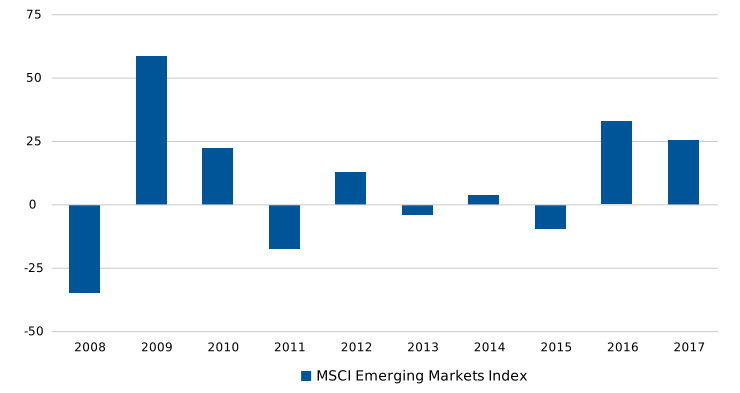
Source: Franklin Templeton Investments. 01/01/2008 to 31/12/2017 in GBP. Past performance is no guarantee of future performance.
Time Frames
However, volatility is only one measure of risk.
- What about the risk of your money not working hard enough for you?
- How do we define the risk of a 30 year old, saving for retirement and sitting in cash, where inflation is beating interest rates today?
- What about a new baby with a cash Junior ISA which will sit there for 18 years?
- What about someone who only has UK shares and our home economy takes a tumble?
What is clear is that any discussion about investment risk has to be had alongside the timeframes in question, and alongside what else you have in your investment basket. The amount of emerging markets investments you hold in your portfolio should be appropriate – that isn’t only appropriate in relation to global markets, but also appropriate in terms of the existing make-up of your portfolio and your own attitudes to risk.
What we’re really saying here is to think carefully about that attitude to risk and what it really means.
So Why Can Emerging Markets Be Volatile?
Emerging markets can face greater volatility when sentiment sours or a good news story hits. Price swings will typically be more extreme than in developed markets. Neither is the process of developing into a developed economy a one-way track. Countries can face political upheaval, natural disasters or a host of other events that may push them back years.
As a collective, emerging markets are also more vulnerable to the consensus view – when the world’s largest funds decide to dial back on emerging markets as a percentage of mixed portfolios, or to go large on developed markets by comparison, these large investors can often move as a herd.
Good current information is also harder to come by.
UK stocks are crawled over by analysts in their 1000s and the reporting requirements are substantial. The research side of the investment world is significant in the UK.
By comparison less developed markets have lower requirements. They are typically less well researched as a collective, and so there is more chance of unexpected negative news. And stock markets hate surprises. Having the right (and extensive) on-the-ground research capability in the emerging markets is the cornerstone of Franklin Templeton’s investment approach.
Emerging markets can rely more on trade and so be vulnerable to currency movements and any trade wars. This has been seen recently in the political spats between the US and China and Turkey.
And lastly, corporate governance can sometimes be less rigid in these markets. At the more extreme end we may see bribery and corruption. Of course, these risks increase the value of great local knowledge and it’s easier to have ‘the edge’ in these markets than in their more mature developed counterparts.
And on the up Side
The opportunities in “new economy” sectors look very different to how they did a decade ago when it was all about more traditional stories such as commodities. Today it’s a story of technology and consumption. Emerging market companies are becoming global innovators in areas such as e-commerce, mobile banking, biotechnologies, robotics and autonomous vehicles.
These markets are more likely to produce companies with explosive growth which jump onto the world stage.
- China’s Tencent is just one example – now one of the largest 5 companies in the world. Some will point to struggles in 2018, but we believe these issues will be overcome.
- India has seen huge integration between mobile communications and healthcare, numerous apps and interphases allow patients to manage long term conditions from diabetes to cardiac care.
- A microfinancing boom in Indonesia has allowed impoverished rural regions access to regulated borrowing producing a new tier of economic exchange.
Finally the volatility described above presents opportunities. Sometimes the herd is wrong and where depressions are driven by sentiment rather than fundamentals, longer-term investors can benefit from unwarranted falls in price.
Diluting the Risk
The secret to adding emerging market growth to your portfolio is to only take reasonable risks.
You could possibly make huge returns by piling your life savings into every Chinese stock on the Shanghai Stock Exchange but the chances are good that you will have trouble sleeping at night whenever Trump waves his fist, there is a riot in China or a private company seizure by the government. This very concentrated gamble would be just that.
Diversification is key. Not all emerging markets are the same and present different risks and opportunities
As always diversification is key. Not all emerging markets are the same and present different risks and opportunities – picking quality companies across a wide range of countries is key. There are better, safer ways to add emerging markets to your investing toolkit than backing just a handful of stocks in a few markets.
Investment Trusts are great for accessing a combined pool of countries and companies so the risk is spread around. For example, the Templeton Emerging Markets Investment Trust has 97 holdings from 22 different countries as at end November 2018.
Emerging markets add variety to a mixed portfolio which would be very one-sided were it all invested in developed markets such as the US, the UK, Germany and Japan. But buckle up for a potentially bumpy ride!